

2026 Online Workshop Series
Open Source Creative AI Tools
This event is passed. WATCH THE RECORDING
Day 3
Fragmenta
We are thrilled to announce a free one-day online workshop designed to introduce Fragmenta. The workshop aims to demonstrate the system’s capabilities and provide participants with a hands-on experience.
Date:
August 21, 2026
10 am – 1 pm PDT
Location:
Online (Zoom)
The Zoom link will be sent to the participants before the workshop.
Presenters:
Dr. Philippe Pasquier
Misagh Azimi
– – – – – – – – – – – – – – – – – – – – – – – – – – – – – – – – – –
Please note the following:
Participants need a Windows, Linux, or Apple Silicon Mac (macOS 14+) with Python 3.11 installed. An NVIDIA GPU with 8GB+ VRAM is highly recommended. Participants without the required hardware are still welcome to join.
This workshop is in English.
This workshop is free.
What is Fragmenta?
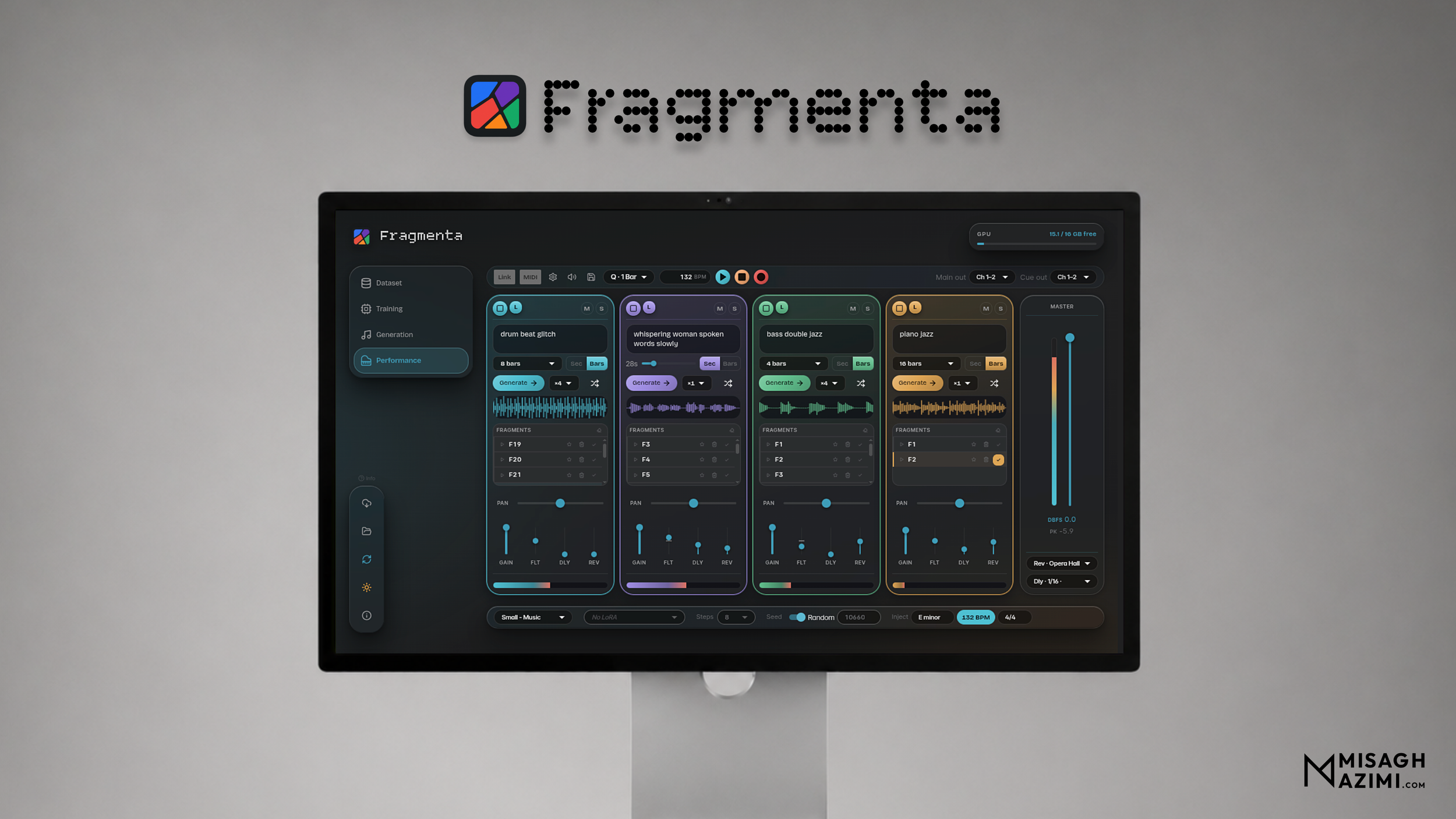
Fragmenta is an open-source desktop application that puts the entire text-to-audio pipeline – dataset building, model training, generation, and live performance – into a single interface, with no coding required. Built on Stable Audio 3, it lets musicians with access to GPUs train LoRA adapters on their own recordings, so the model is bent toward a personal sonic vocabulary rather than a generic one. Everything runs locally: after a one-time model download, no audio ever leaves the machine. This small-data, artist-first approach offers a transparent and ethical alternative to subscription-based commercial tools and is aimed at artistic experimentation and individualized creativity.
Who is this workshop for?
Our workshop welcomes musicians, composers, sound designers, and sonic artists at any level of technical experience – those curious about what training a model on their own archive actually involves, as well as those looking to bring generative audio into a live or studio practice.
What will be covered?
The workshop opens with the reasoning behind Fragmenta, followed by a brief explanation of the technologies underpinning it. Participants will then be guided through the download and installation process, and from there through the full pipeline in sequence: assembling a dataset in the Dataset Workbench, captioning it by hand or with the built-in auto-annotation, training a LoRA adapter, and generating from the result. The session closes with Performance Mode, a four-channel sampler with MIDI learn, which we will demonstrate as a live instrument.