
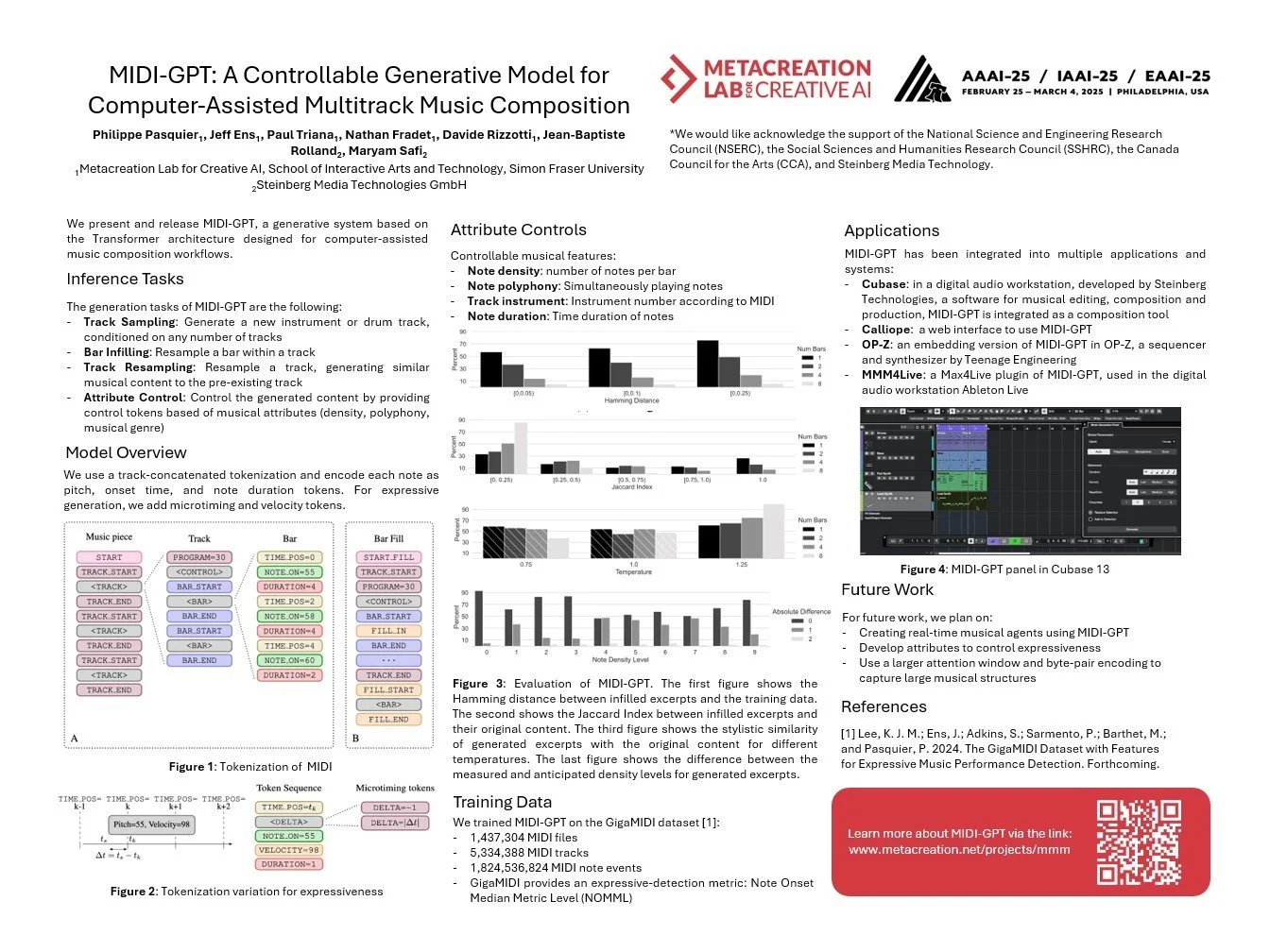
MIDI-GPT is a generative system developed by the Metacreation Lab for computer-assisted music composition. It is based on the Transformer architecture and is designed to be style-agnostic, expressive, and steerable. It is the latest model in the Multi-track Music Machine (MMM) family, and it is open source.
Key features
Multi-track support: an alternative representation decouples track information from note tokens, so MIDI-GPT handles all 128 General MIDI instruments and can generate more than 10 tracks at once, depending on their content.
Flexible input and output: General MIDI in and out, with no fixed instrument schema, so it fits a wide range of user workflows.
Controllable generation: unconditional generation, continuation, infilling at the track and bar level, and attribute control.
Attribute controls: instrument type, style, note density, polyphony level, and note duration, using categorical, value, and range controls. Instrument is a categorical control, note density is a value control, and note duration and polyphony are range controls. Newer checkpoints add key signature, pitch range, silence proportion, pitch class set, and genre conditioning.
Expressiveness: velocity and microtiming tokens let the model generate expressive music. DELTA tokens encode the time difference between the original MIDI note onset and the quantized token onset.
Models
Pretrained checkpoints are published on Hugging Face and load with a single call from the midigpt Python package.
yellow: the baseline model. Context windows of 4 or 8 bars, with infilling and controls for note density, polyphony, and note duration. A good default for most composition tasks.
prism: context windows of up to 16 bars, plus the wider set of attribute controls (key signature, pitch range, silence, bar-level density and polyphony, pitch class set, and 18 genre groups).
expressive: adds sub-grid microtiming, 128 velocity levels, a rhythmic-quantization control, and piece-level switches for velocity and microtiming, for output that feels less quantized.
The prism and expressive checkpoints were still training when this page was written; see the model card on Hugging Face for the current status.
Tokenization
MIDI-GPT uses two main tokenizations.
Multi-Track representation: each bar is a sequence of tokens, including NOTE ON, TIME POSITION, and DURATION tokens. Bars are delimited by BAR START and BAR END tokens, tracks by TRACK START and TRACK END tokens, and the piece begins with a START token.
Bar-Fill representation: bars to be predicted are replaced with a FILL IN token and placed at the end of the piece, between FILL START and FILL END tokens. This enables bar-level infilling.
Training and evaluation
The system was trained on the GigaMIDI dataset and evaluated for originality, stylistic similarity, and the effectiveness of its attribute controls. The results showed that MIDI-GPT generates original variations and maintains stylistic similarity to the training data. The note density and note duration controls were effective, while polyphony control was less so.
Software and integrations
MIDI-GPT is being integrated into synthesizers, game music software, and digital audio workstations:
MIDI-GPT for REAPER: open-source plugin for the REAPER DAW
MMM-Cubase: Cubase plugin (research prototype)
MMM4Live: plugin for Ableton Live
OP-Z: pattern generation for the Teenage Engineering OP-Z synthesizer
Calliope: web environment for computer-assisted composition
It has also been used in artistic projects, including entries to AI song contests and the creation of music albums, to compose adaptive music for games, and in an artistic residency. See Music with MMM.
Workshop
The Metacreation Lab ran a free online workshop on MIDI-GPT with Philippe Pasquier and Paul Triana on August 19, 2026, as Day 1 of the Open Source Creative AI Tools workshop series. Watch the recording or see the workshop page.
Get started
Python package on PyPI: pip install "midigpt[inference]" (Python 3.10 to 3.12)
Ethical considerations
MIDI-GPT inherits the biases present in its training dataset, which may underrepresent certain musical styles. The legal status of such a model is unclear, and its use has been restricted to non-commercial purposes so far.
Future work
Future work includes optimizing the model for real-time generation, training larger models, expanding the set of attribute controls, and continuing to integrate MIDI-GPT into real-world products and practices.
License
The MIDI-GPT code is released under the MIT license.
Papers and Posters
Pasquier, P., Ens, J., Fradet, N., Triana, P., Rizzotti, D., Rolland, J.-B., & Safi, M. (2025). MIDI-GPT: A Controllable Generative Model for Computer-Assisted Multitrack Music Composition. AAAI 2025. arXiv:2501.17011